O'Brien & Bails

Michigan Court Reporters

  • Home
  • About
  • Services
    • Court Reporting & Video
    • Records Retrieval
  • Schedule/Order
    • Upload Exhibit(s)
    • Order Transcript
  • Resources
    • Events & Webinars
    • Portal Sign Up
  • Blog
  • Contact
    • Map of Locations
    • Email Us

December 11, 2014 By Dawn Houghton

How to Prepare a Legal Deposition Notice

As a legal professional, there may be a time when you need to prepare a legal deposition notice. Preparing a notice of deposition is not a difficult task as long as you know what to include in the notice.

What Is a Notice of Deposition?

A document directing a witness to appear to answer questions under oath is called a notice of deposition. The notice includes a time and place where the examination is to occur. The notice is sent to all parties in a lawsuit so that everyone involved has been given notice of the event.

How Do I Prepare a Notice of Deposition?

In our experience, most legal professionals learn how to create a deposition notice by referring to one their firm has used in the past and using it as a template. Many law firms and attorneys have preferences for the exact language that will be used in the notice. However, if you have never prepared a notice of deposition and you have not been given a sample, we have some simple instructions to get you started.

First it is necessary to understand the parts of a deposition and what should be included.

Caption

The full caption of the case should be included at the top of a notice of deposition. This will include the jurisdiction in which the case has been filed, the file number, and name of plaintiff(s) and defendant(s).
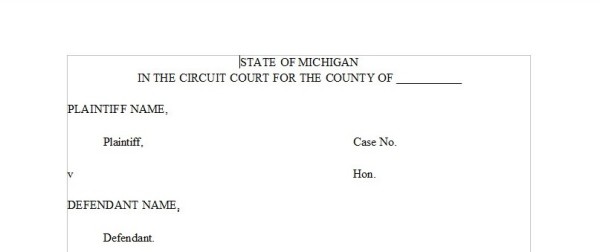
Deposition Notice Sample 1


Names and Addresses of Attorneys

The names and addresses of each attorney of record should be included on the notice. Be sure to include the attorney’s bar number and designate which party the attorney is representing. You should also include the name of an attorney’s law firm, full street address, telephone number, fax number and email address.
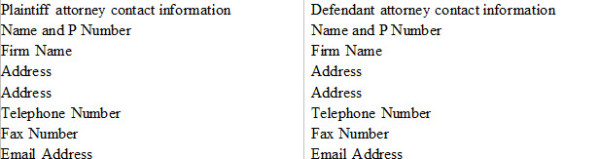
Deposition Notice Sample 2


Type of Notice

The title of the document should include the type of notice you are preparing. There are several types of deposition notices and including the title will provide clarification of which type you are preparing.

Date, Time and Location

The date, time and location should be prominently included in the notice language. Using bold type is a nice way to draw attention to this information on the notice.
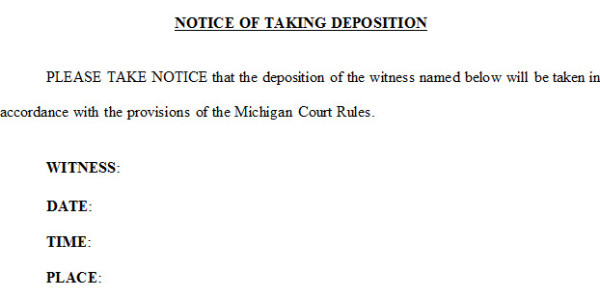
Deposition Notice Sample 3


Signature Block of the Requesting Attorney

Including the requesting attorney’s signature block at the end of the notice allows everyone to be clear on who is calling for the deposition.

Deposition Notice Sample 4


Putting It All Together

Below is a simple Notice of Deposition sample showing you all of the pieces put together to create the full document.
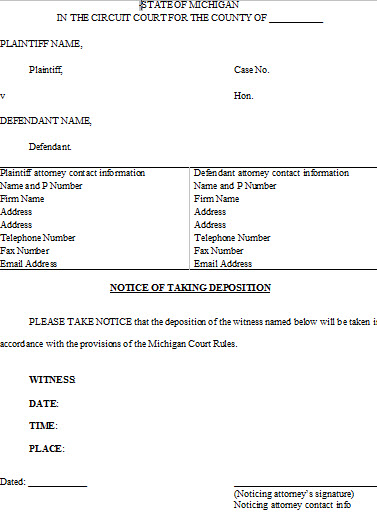
Full Deposition Notice Sample

Filed Under: Legal Professionals

November 14, 2014 By Dawn Houghton

Easily Connect to Your Court Reporter’s Realtime Transcription

How To Connect To RealtimeAt O’Brien and Bails, we have been providing realtime transcription for quite some time. Our clients find great value in viewing the transcribed spoken word as it is happening. If you’ve never connected to realtime in a deposition before, you may think it is technically difficult. But connecting to realtime is actually simple. Once you know what is involved, you will see that using realtime in your next deposition can be easy and of great value to you and your clients.

What is Realtime Transcription?

In a nutshell, realtime transcription is a system whereby the spoken word is recorded by the court reporter and delivered as text on a computer screen within a few seconds of the words being spoken.

Valuable Features of Realtime Transcription

  • A rough draft of the written record is available shortly after the proceeding has ended.
  • You have the ability to search for keywords in the text.
  • Text can be copied and pasted into other documents or emails.
  • Transcripts can be shared by the Internet or email.
  • During the deposition, reference can be made to previous testimony.
  • Drafts can be used to organize the next deposition you may be taking.
  • Answers can be reviewed immediately, giving you the opportunity to ask for further clarification if necessary.

How to Connect to Realtime

Connecting your computer to realtime is not difficult. Each court reporting firm may use different software and the process may vary from system to system. It is a good idea to call your court reporting firm before the deposition and ask for a set of instructions for connecting to your court reporter’s specific software.

At O’Brien and Bails, we use two software programs to deliver realtime transcription; Eclipse and CaseViewNet. Some of our reporters use Eclipse, and others use CaseViewNet. These software programs allow us to provide instant realtime text. No matter which program your court reporter is using, you will not need to purchase software or tokens in order to connect to realtime.

Connecting to realtime is easy. Here are the steps involved in connecting with a wireless connection that your court reporter will provide. The first set of instruction is for CaseViewNet. The second set is for court reporters using the Eclipse software.

CaseViewNet Software Realtime Connection

1. Connect to the court reporter’s wireless network.

  • Verify that your computer is WiFi enabled. View or connect to the available wireless networks by right-clicking the wireless icon on your Windows taskbar.
  • Choose the court reporter’s wireless network from the available networks.
  • If required, enter the network key (pass phrase) provided by the reporter.

2. Connect to the court reporter’s realtime system.

  • Start CaseViewNet client software.
  • Click the Connect button.
  • Follow instructions in the Connection Wizard.

3. Provide your log-in credentials and connect to the event.

  • Use your name and the name of your organization.
  • Provide the event password as provided by the court reporter.

Simple instructions for connecting are provided by CaseViewNet on their website. They also provide instructions for connecting by serial port if wireless is not available.

Eclipse Software Realtime Connection

If your court reporter is using Eclipse software, the following instructions are the ones you will follow to gain a realtime connection on your computer:

1. Go to https://connect.eclipsecat.com.

2. Click the lightening bolt symbol in the lower left-hand corner of your screen.

3. Scroll to find the transcript with which you wish to connect.

4. Enter the password you have been given from your court reporter.

We Make it Easy for You to Connect

Realtime transcription can be a huge benefit to attorneys when preparing cases. We strive to provide realtime in a way that is easy and uncomplicated. If you haven’t connected to realtime transcription in a proceeding before, as you can see, it is a simple process. Your court reporter is available to assist in making the connection so you can receive realtime transcription on your computer and reap the benefits in your next deposition.

Filed Under: Legal Technology

September 5, 2013 By Dawn Houghton

Court Reporting – A Profession, Not Just a Job

Court Reporting ProfessionWhat is the difference between a job and a profession? A job typically requires minimal experience and education. All that is needed is a minimum amount of skills to get the job done. A profession requires a high level of knowledge and skills. Individuals in professions are not easily replaceable since their education, extensive training, and skills make them unique assets. As a result, professions generally have higher levels of compensation.

High Skill Levels

Court reporters must graduate from an accredited court reporting program at the writing speed of 225 words per minute. Court reporting students learn a writing theory called “stenographic shorthand”, which they must know how to read and write on their stenographic machines. Stenographic machines enable reporters to write at a faster rate through condensing words to phonetic syllables. This method is much faster than typing on a QWERTY keyboard. The language of court reporting is complicated, and students must become proficient at this unique skill.

Reporters typically spend several hours writing the verbatim testimony of witnesses. However, work doesn’t end when they leave the office. Reporters then return to their home or office to edit, research and proof for several more hours. A good rule of thumb is if the writing of the testimony took an hour, it will take two to three hours to edit, research, proof and produce into a transcript that hour of testimony.  Because a reporter’s job is centered around writing, transcribing, and editing, excellent verbal skills are required. It is imperative that reporters are well-read and educated so that transcripts are accurate and coherent. Reporters should always be in pursuit of enhancing their verbal and word recognition skills.

Professional Association Participation

Reporters typically belong to various court reporting associations such as the National Court Reporter’s Association (NCRA) or state-specific organizations such as the Michigan Association of Professional Court Reporters (MAPCR). These organizations provide great opportunities to network with other agencies and reporters. They also hold conferences where they meet and educate reporters on current trends, issues, or new technology. For example, the NCRA holds major conferences in different states each year. Reporters can attend special speaking engagements or even be the first individuals to experience new reporting technology.

The NCRA is also responsible for national court reporting certifications. Although being a member means you must pay an annual fee, being certified puts you at an advantage. It communicates to attorneys and agencies that you are a qualified and competent reporter because you have to pass written and practical tests with each certification that proves you are at the certified level. Being certified leads to better opportunities and levels of compensation.

A Diverse and Enriching Profession

People often misconceive that reporters are merely individuals who take down the record, go home, print out the transcript, and that’s the extent of their occupation. But there is far more to the profession than what they often realize. Not only does reporting involve extensive education and training, but a reporter’s education extends beyond school. A wise reporter never stops learning and enhancing their skills, often doing research and extra reading on various topics in order to broaden their scope of understanding of the world around them. Reporters often attend conventions, conferences, and become certified for the sake of building their career. For these many reasons, court reporting is a profession and not just a job. Court reporting is far more diverse and enriching than what a typical job can offer.

If you found this article interesting, you might also be interested in “The Top 10 Skills of the Best Legal Assistants.”

Filed Under: Court Reporters, Court Reporting

August 30, 2013 By Dawn Houghton

Court Reporting Certifications and Standards

Court Reporting CertificationsThe skills required to be a court reporter are numerous. You have to be able to write accurately at high rates of speed. You need specialized knowledge in many areas, such as legal procedures, grammar, punctuation, technology and professional practices.
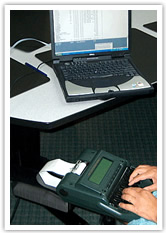
The National Court Reporters Association offers many certifications at different skill and experience levels in the court reporting industry. These certifications are designed to present high standards by which court reporters practice their profession. These standards allow for more uniform practices by court reporters all over the country. The standards are high and many reporters have attained several of these certifications.

If you are not familiar with the various types of certifications NCRA offers, here is a listing with NCRA’s descriptions of what is required to receive the certificate.

RPR (Registered Professional Reporter)

The RPR is a prerequisite for the RMR and CRR. It is divided into two portions: written knowledge test (WKT) and skills knowledge test (SKT). The WKT is a 115 multiple-choice test measuring your knowledge in technology, reporting and professional practices. You must pass with a scaled grade of 70 or higher. The SKT consists of 180 words per minute literary, a 200 words per minute jury charge, and 225 words per minute Q&A. You must pass with a 95% accuracy.

RMR (Registered Merit Reporter)

To qualify, you need to be RPR certified and an NCRA member. The SKT is 200 words per minute literary, 240 words per minute jury charge, 260 words per minute Q&A. Passing grade is 95% accuracy.

RDR (Registered Reporter)

You must be an RMR and hold a continuous NCRA membership status. The exam is a 115 multiple-choice test on technology, reporting and professional practices. To pass, you must attain a scaled score of 70 or higher.

CRR (Certified Realtime Reporter)

To qualify, you must be an NCRA member and an RPR. The SKT is a 200 words per minute two-voice Q&A. You must achieve 96% accuracy.

CBC (Certified Broadcast Captioner)

You must be an NCRA member. The exam is divided into two parts: written and skills. The WKT is a 100 multiple-choice test that measures your knowledge on writing realtime, language skills, realtime writing, and research. You must pass with a scaled score of 70 or higher. The SKT is a five-minute, 180 words per minute literary test. You must pass with 96% accuracy.

CCP (Certified CART Provider)

You must be an NCRA member. There are two portions of the exam: written and skills. The WKT is a 100-question, multiple-choice test on your knowledge on writing realtime, research, language skills, and Communication Access Realtime Translation. The SKT is a five-minute, 180 words per minute literary test. You must pass with a 96% accuracy rating.

CVLS (Certified Video Legal Specialist)

This certification qualifies you as a legal videographer. First, you must attend a two-day seminar called, “Video in the Legal Environment”. Second, you must pass a 100-item multiple-choice test (passing score only stays on your record for three years). Third, you must pass a hands-on production examination. This is where you are graded on your video abilities in mock depositions. Again, your passing score only stays on your record for three years.

CRI (Certified Reporting Instructor)

This professionally certifies and qualifies court reporting teachers. You must either be an educator, administrator or reporter. You must also be an NCRA member beforehand. To become certified, you must attend a 13-hour NCRA Council on Approved Student Education Sponsored Orientation Session for CRI. This certification is valid for three years upon completion of seminar.

MCRI (Master Certified Reporting Instructor)

This is the highest merit for a reporting instructor. It is divided into four parts:

Part 1: You must have a Bachelor’s degree, be CRI certified, currently teach in a court reporting program, have five years teaching experience in a court reporting program, provide evidence of professional and community involvement, and write an essay on your philosophy of education.
Part 2: You must compile a portfolio within one year of admission. Your portfolio will provide evidence of your professional development in the last five years. It will include evidence of superior teaching, court reporting knowledge, teaching pedagogy, and professional community service.
Part 3: You must complete at least 70% of the RPR and MCRI written tests.
Part 4: You must maintain your certification by submitting your curriculum vitae by June 1st of the year the MCRI is going to expire.

CPE (Certified Program Evaluator)

This certifies the individual in evaluating and certifying undergraduate court reporting programs. You must take two e-seminars (“Interpersonal skills” and “Introduction to the CPE certification”).

If you liked this article, you may also be interested in “The Transition from Court Reporting Student to Working Court Reporter”.

Filed Under: Court Reporting

August 1, 2013 By Dawn Houghton

The Court Reporting Profession is Alive and Well

court reporting professionFor years, people have been warning court reporters and students that the future of court reporting is doomed. But contrary to the warnings, the industry has not collapsed. It is alive and well, even thriving due to advancements that have strengthened the profession.

Over 30 years ago, when I became a court reporter, I heard the warnings, “Court reporters will be replaced by electronic recording….you won’t have a job once video replaces you…voice recognition is going to kill court reporting.”

Over the years, I have seen these arguments and many more fall by the wayside. One by one, they were proven wrong as our skills grew stronger, our technology blossomed, and new career paths opened up that widened our profession. A career in court reporting is as stable today as it was years ago when I first began reporting.

Projections

The United States Department of Labor, Bureau of Labor and Statistics publishes the Occupational Outlook Handbook. This handbook is a source for career information about many different professions. The profiles feature hundreds of occupations and describe the occupations, the work environment, how to enter the field, and more. Each profile also includes employment projections for the 2010–2020 decade. The Occupational Outlook Handbook lists court reporting and gives facts about the industry that are beneficial to anyone who is thinking of entering the field. These facts are also reassuring to court reporters who are still hearing warnings of job shrinkage.

There are currently 22,000 court reporters estimated to be employed in the United States. The Bureau of Labor and Statistics projects this number to grow by 14% from 2010 to 2020. This is hardly an indication of a shrinking job market. In fact, the field is expected to grow at an average pace when compared to other occupations.

New Technology

The technology of court reporting has evolved over the years, and continues to advance as computers and the internet advance in sophistication. For years, the only technology used was a stenotype machine and a typewriter.

In the early ’80s, computer-aided transcription became the norm. Court reporters were able to teach computers how to read steno notes and help turn those notes into transcripts. Over the years, the computer-aided technology has developed into realtime reporting, allowing our steno notes to be instantaneously translated at a high rate of accuracy.

Video began to be incorporated to allow for video depositions accompanied by traditional transcription. With the evolution of the Internet, we now have the capability to transmit video, audio and realtime transcription to remote locations. The realtime nature of this new technology means parties can effectively participate in proceedings that are taking place in different geographical locations without leaving their own office.

These new technologies allow court reporters to not only stay relevant to legal proceedings, but also offer wider and more convenient services to clients

New Skills

With the new technology of computer-aided transcription in real time, court reporters began to evolve the traditional shorthand theory into a new system of writing that allowed for more accurate realtime transcription. Over the last 20 years, many reporters have retrained themselves in a new way of writing. This higher level of realtime accuracy allows reporters to project realtime translation and also deliver a highly accurate rough draft immediately upon the conclusion of the proceedings. The realtime translation is helpful to the attorneys while they are asking their questions of the witness.  The rough draft being supplied is popular for attorneys preparing for an upcoming trial who want the convenience of having the written testimony in front of them immediately after the proceedings have concluded.

Another skill that has developed in the last couple decades is legal video. The profession, as a whole, has pioneered legal video and streaming video so that they may deliver these services to clients who can take advantage of the technology and use it to their best benefit. The National Court Reporters Association offers certification for videographers who are interested in providing a high level of professional legal video to clients. This standardization allows the court reporting industry to continue to provide highly professional video for legal use.

The ability to commandeer these new technologies and use them to offer a wider variety of services has allowed court reporters to continue to stay relevant over the years.

New Career Paths

Once reporters adapted their writing to provide highly accurate realtime translation, reporters began offering their services to the deaf community and people who are severely hard of hearing. These realtime skills are now employed to provide broadcast captioning of live television shows, such as news broadcasts. Television captions are typically created before a show airs. In the case of live television shows, there is no opportunity to create captions before the show airs. Working with television stations, court reporters began using their skills to translate the spoken word in realtime and send it out with live television shows.

Realtime also became the method to provide Communication Access Realtime Translation (CART) to individuals in schools, the work place and live theater. With the CART provider writing what is being spoken, the person receiving assistance can then read the captions from a computer screen and is able to participate in live discussions that would typically be extremely difficult without the live captions being provided.

These new fields of broadcast captioning and Communication Access Realtime Translation has broadened a court reporter’s choices of fields to work in and expanded the number of jobs available in the profession.

A Profession That is Strong and Growing

This equation of new technologies, new skills and new career paths adds up to a profession that is alive and thriving. When people tell me court reporting is dying, I know they are wrong because of the developments I have watched and participated in over the years. The truth is the field of court reporting is stronger now than ever.

Filed Under: Court Reporters, Court Reporting

  • 1
  • 2
  • 3
  • …
  • 5
  • Next Page »

Copyright © 2025 · O'Brien & Bails | Michigan Court Reporters
251 N. Rose Street, Suite 200
Kalamazoo, MI 49007-3943
(Get Directions)
269.345.8436 · 800.878.8750 · Email Us
Image Credit