O'Brien & Bails

Michigan Court Reporters

  • Home
  • About
  • Services
    • Court Reporting & Video
    • Records Retrieval
  • Schedule/Order
    • Upload Exhibit(s)
    • Order Transcript
  • Resources
    • Events & Webinars
    • Portal Sign Up
  • Blog
  • Contact
    • Map of Locations
    • Email Us

March 28, 2013 By Dawn Houghton

How Much Does It Cost to Hire a Court Reporter?

court reporter costFrom time to time we get asked the question, “How much does it cost to hire a court reporter for a legal deposition?” Often this question comes from a new attorney, a legal assistant, or a plaintiff or defendant not familiar with litigation practices. To answer the question, let’s first define “legal deposition.”

A deposition is testimony given by a plaintiff, a defendant or witness in a lawsuit before the case actually goes to trial. The person giving the statement is called the deponent. At the beginning of the deposition, the deponent is asked to swear or affirm that the statement will be truthful. The deposition is taken by a lawyer asking questions of the deponent. Usually, the lawyer for the plaintiff will take the deposition of the defendant, and the lawyer for the defendant will take the deposition of the plaintiff. However, other people with knowledge in a lawsuit may also be deposed. Either lawyer may take the deposition of these other people who have knowledge important to the case.

The deposition is taken down stenographically and transcribed by a court reporter. The court reporter’s fees will often include an hourly appearance fee, a fee for each page of the transcript produced after the deposition, as well as other costs such as fees for copying and attaching exhibits that were marked during the deposition.

Appearance Fees:

The appearance fee is typically an hourly fee charged for the time the court reporter actually spends at the deposition. If neither party requests that the transcript be prepared after the deposition, then the fee to the noticing party will usually include a non-write hourly appearance to cover the court reporter’s time during the deposition.

Page Fees:

The larger cost of hiring a court reporter is often the cost of the transcript. When one party orders the transcript, the court reporter will prepare a written record of the testimony, as well as charge a fee per page of transcription.

The attorney who orders the transcript will be charged a higher fee for the “original” transcript. Other parties may order copies of the transcript for a lesser page rate after the “original” has been ordered by a party.

If a transcript is ordered on an expedited or rush basis, the per-page rate can increase by 40% to 100% per page depending on the time of the requested delivery.  It will be more expensive to order daily delivery of a transcript versus two- or three-day delivery.  If you do need a transcript in a hurry, be sure to inform your court reporting agency as soon as possible so they can make the necessary arrangements. They will be able to tell you what the expedited page rate will be.

Most court reporters will provide a transcript prepared according to industry standards. On average, a standard deposition page is 25 lines per page, and 50 to 65 characters per line, although each State may have their own format rules the court reporters must follow.

In the State of Michigan, court reporters are provided with the standard format to follow that is outlined in the Michigan Manual for Court Reporters and Recorders which they must adhere to. There is not a specific character per line stated in the Manual, but from our calculations when using the instructions provided from the State of Michigan, we believe the characters in the longest line on the transcript falls in the 65 characters per line range.  This can be a very important distinction when calculating how much your transcript will really cost.

Additional Charges:

There are additional charges which may be incurred during a deposition. Most court reporters will retain any exhibits marked during the deposition and make copies to attach to all transcripts and usually will attach the original exhibits to the original transcript. Copy charges can range from 20 to 40 cents a page for black and white copies to a dollar per page or more for color copies or oversized copies. These rates are set by each court reporting agency and may vary.

Shipping and handling charges may also be included in the price of transcript. These fees can vary from agency to agency as well.

Some court reporting agencies also charge fees for condensed transcripts, ascii versions of the digital transcript, or keyword indexes. At O’Brien and Bails Court Reporting, we do not charge extra for these items.

When calling your court reporting agency to schedule a deposition, it is a good idea to ask about these charges as they do vary from agency to agency, and it is important to be aware of the format the agency is using in order to accurately compare the page rates.

Filed Under: Court Reporters, Court Reporting

February 8, 2013 By Dawn Houghton

Streaming Realtime Transcription For Legal Depositions

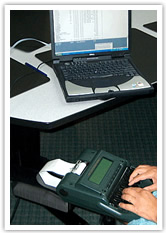
streaming realtime transcriptionStreaming Realtime transcription is the term for transcription by court reporters to deliver computer text of speech over the Internet within seconds of the words being spoken. Realtime can also mean transmitting audio and video of the proceedings. Users can see the text and video from any computer with Internet access as the witness answers questions. Streaming realtime can be viewed from any computer, whether in the same room as the proceedings or viewed remotely from another location.

Here are some of the benefits of using realtime transcription:

View text and video in real time during the proceedings.

This form of streaming transcription is accessible as it happens in real time. An attendee may not be in the same room, but through streaming realtime, they can watch from their office or remote location and see what is happening as it unfolds. No longer will you need to obtain a video to send to the party who wishes to see it.

Attend and participate in depositions from any computer remotely.

Streaming realtime can cut down on your travel time. Rather than driving for hours for a short deposition in which you are going to ask only a couple questions, you can now hire a court reporter to provide streaming realtime which you can access from your desk. Streaming realtime allows you to not only view but also participate in the deposition.

Carefully review testimony during proceedings as needed.

Unlike a regular video dep, streaming realtime allows you to see the written words on your computer screen as it happens. This can make it easier for you to follow the testimony and carefully review areas of special concern as they are being spoken.

Quickly search text during the proceedings.

As you are listening to the deposition, if you find a need to go back and review previous pieces of testimony, you can do so with streaming realtime transcription. You can then direct attention to the necessary areas of testimony, rather than wait until the transcript is prepared.

Easily search text and video, and view them simultaneously once proceedings have ended.

There may be portions of the video and transcript you want to review immediately after the deposition has concluded. You will be able to search text and video to review those portions of interest. A transcript may not be ready for several days. This feature allows you to review while the entire deposition is still fresh in your mind.

Obtain a rough draft copy of the transcript after proceedings have concluded.

If you want to send the testimony to an expert witness as soon as possible, obtaining a rough draft copy will allow you to do so. You may have a quick deadline coming up and need to be sure your witness has reviewed the testimony.

Getting Started:

When scheduling a deposition, ask your court reporting firm if they provide realtime text and video streaming. Realtime transcription is often provided at higher rates than regular transcription as it takes a more specialized and experienced court reporter, so be prepared to pay a little more for the convenience of realtime transcription.

If you would like to schedule a deposition with O’Brien and Bails Court Reporting, you can now do so online with our Deposition Scheduler. We will be happy to take care of the details for you.

Filed Under: Legal Professionals, Legal Technology

January 17, 2013 By Dawn Houghton

10 Notable Legal Courtroom Scenes in Movies

legal courtroom scenes in moviesAs court reporters, we are very critical of courtroom scenes in movies. Often, they are unrealistic and contain inaccurate procedures. Since we see a lot of testimony, courtroom scenes in movies often do not live up to the real thing.

We’ve discovered this list of ten notable courtroom scenes. Whether accurate or not, this is a pretty good list of entertaining courtroom scenes. The next time you’re looking for something good to rent or watch on Netflix, give one of these a try.

The movies are not necessarily about the legal system themselves but still contain a memorable scene. CAUTION: there may be some spoilers here.

10 Notable Courtroom Scenes In Film
by ericvg16, November 3, 2012

10. A Tap Dance – Chicago (2002)

“Ladies and gentlemen, a tap dance.” Taye Diggs’ lead-in sets the stage (figuratively and literally) for Richard Gere’s Billy Flynn to engage in some courtroom histrionics. Claiming “I’ve never lost a case,” Flynn’s tap dance is juxtaposed with him working over Velma Kelly (Catherine Zeta-Jones) and making prosecutor Harrison (Colm Feore) look like a complete fool. He even manages to imply that Harrison is complicit in setting up Roxie. The coup de grâce is when he furiously bangs the judge’s gavel several times, and then, out of breath, turns to the courtroom and exclaims, “The defense rests!”

9. Legally Blonde (2001)

Admittedly, the movie is probably a little kitsch, but Reese Witherspoon’s portrayal of Elle Woods catapulted her into the stratosphere of Hollywood. The scene that stands out is when pool boy Enrique, rumored to be the lover of accused murderess Brooke Windham, is examined by Emmett (Luke Wilson). While getting a drink of water, Enrique snaps about not tapping her Prada shoes at him. She becomes convinced that he’s gay and lying about his relationship with Brooke. Only Emmett believes her and ingeniously baits Enrique by finally asking him, “And your boyfriend’s name is..?” to which Enrique responds, “Chuck,” thereby falling into Emmett’s trap.

8. A Time to Kill (1996)

For all of the knocks about Matthew McConaughey, his closing summation in A Time to Kill is one of his best acting performances. After floundering to save defendant Carl Lee Hailey, his character, Jake, finally hears Carl Lee’s argument that he is “one of them,” that is, a white man in the Deep South. No matter who he claims to be, Jake will still be seen as “one of them.” Carl Lee asks Jake to use that to his advantage, and Jake does so as he delivers a solemn closing argument that extols the nature of man and how pervasive double standards are.

7. Anatomy of a Murder (1959)

Played with the usual “aw, shucks” demeanor by the late great Jimmy Stewart, defense attorney Paul Biegler is assigned to a murder defendant whose wife had an affair with the victim, Quill. After being railroaded by both the prosecution and the judge, Biegler finally appeals to the judge and laments that the prosecution is presenting its case based on circumstantial evidence. He compares it to “removing the core from an apple without removing the skin,” and begs the judge to “let me cut into the apple.” After the prosecution attempts to object to his methods, the judge reluctantly overrules the objection, setting up a dramatic finish, including a fantastic summation from George C. Scott.

6. Primal Fear (1996)

Edward Norton’s film debut couldn’t have started off any better – he received a Best Supporting Actor Oscar nomination. Playing murder defendant Aaron Stampler, a stuttering altar boy, Norton is put on the stand by prosecutor Laura Linney, and, true to form, stutters, and has trouble answering her questions. Until, that is, he is pushed too far, and his altar ego “Roy,” a violent sociopath (and no stutter), emerges. He jumps over the box and begins to choke her, threatening to break her neck. This is enough to condemn him to a mental hospital. However, it turns out that it was all a ruse – as the defendant responds to his attorney Martin Vail (Richard Gere again) that “there was never an Aaron, counselor.”

5. Inherit the Wind (1960)

Both leads (Fredric March and Spencer Tracy) were multiple Oscar winners, and it shows. Based off the Scopes monkey trial, Drummond (played by Tracy) is being stonewalled by Brady (March) and the judge, so he resorts to his last option: putting Brady on trial as an expert on the Bible. Brady starts out confident, but after pointing out that “if the Lord wants a sponge to think, it thinks!” Drummond is able to trap Brady in the uncertainties of the Bible and how it contradicts itself. Ultimately, while Cates is found guilty, Drummond’s argument is enough to get him off with a slap on the wrist. A powerful performance from both of these men.

4. A Few Good Men (1992)

We all know this scene for Jack Nicholson’s memorable quote, “You can’t handle the truth!” However, the entire testimony from Col. Jessep and the cross-examination from Tom Cruise makes this scene brilliant. Additionally, Kevin Bacon, representing the military, forces Cruise to be on his toes the entire time; how he manages to trap Jessep in his lies is no small feat.

3. Kramer vs. Kramer (1979)

In actuality, both Dustin Hoffman and Meryl Streep’s testimony in their custody battle is moving and certainly relevant. However, Streep’s Joanna Kramer is able to express her love and fears and hopes for their son, Billy, all the while being badgered by Ted’s attorney. She keeps insisting that the marriage “wasn’t a success,” but the attorney argues, “Not it, Mrs. Kramer. You.” Finally, they both snap and Joanna tearfully admits her mistakes. It is likely that this scene is the clincher that gave Meryl Streep her first of three Oscars.

2. Witness for the Prosecution (1957)

This film certainly has the best ending of all these films, both for the twist and for the superb performance of Marlene Dietrich, Charles Laughton, and Tyrone Power. Defended by Sir Wilfrid Robarts (Laughton), murder defendant Leonard Vole looks unlikely to win his case when his wife, Christine (Dietrich), makes the controversial decision to testify against him (despite spousal privilege), indicating that he is guilty. After receiving a phone call from an anonymous woman that discredits Christine’s testimony, Sir Wilfrid is able to get Vole off. In a twist, it turns out that the anonymous woman was Christine herself. The ending can be summed up in two lines:

“You knew he was innocent, and I understand that.”
“No, Sir Wilfrid, you have it all wrong. I knew he was guilty.”

1. To Kill a Mockingbird (1962)

I think to many, this one was no surprise. Gregory Peck’s portrayal of Atticus Finch in To Kill a Mockingbird not only won him an Academy Award but also was named the greatest movie hero of all time, ahead of Luke Skywalker, Indiana Jones, and numerous others. While defending Tom Robinson, and knowing he isn’t going to win despite evidence that Robinson couldn’t have done it, Atticus barely raises his voice. He begs the court to “believe in Tom Robinson.” Peck’s baritone voice demonstrates everything that is indeed heroic about Atticus Finch. The ending of the scene is one of the amazing moments in cinema – as Atticus solemnly puts away his attaché case and walks out of the court room in defeat, what Reverend Sykes says next to Scout Finch demonstrates the immeasurable respect Atticus has earned: “Miss Jean Louise, stand up. Your father’s passin’.” And with that, Atticus leaves the courtroom, knowing that while he had little chance, it was his duty as a father and a man to fight for justice.

Filed Under: Legal Professionals

January 5, 2013 By Dawn Houghton

Every Day in Court Reporting Is Different

O’Brien & Bails isn’t just another court reporting firm.  We are made up of individual people who happen to be Michigan court reporters.  We thought we would take some time to let you get to know our court reporters.

Yvonne Lantz has been a court reporter since 1972.  She has been with O’Brien and Bails since 1992, and is based out of our Lansing, Michigan office.

Yvonne Lantz - court reporterHow long have you been a court reporter?

Since 1972.

How long have you been with O’Brien and Bails?

Since September 1992.

Have you ever worked in other jobs or fields besides court reporting?

Only the usual high school and college jobs, such as at a drive-in, in the high school office, at a local radio station, and worked for a pharmacy professor while in college.

Where did you grow up?

My first 11 years were in Belleville, Michigan, then we moved to Niles, Michigan

What changes have you seen in the industry since you became a court reporter?

Transcripts were produced by either dictating or typing it yourself. We had to use carbon sets, up to four or five pages at a time, and then manually try to put corrections in the typed document. Computer-aided transcription and realtime have been wonderful advances.

What is the best part of being a court reporter?

Every day is different, especially as a freelancer. I like going to different places, working with different people, and learning something new almost every day.

What is the most challenging part of being a court reporter?

Trying to keep up with people talking at the same time, especially when attorneys are arguing.

As a court reporter, what is your biggest fear?

That I will show up at a job and have my equipment malfunction.

What has been your most challenging deposition?

There have been quite a few, from veterinarians at MSU, physicians in all kinds of specialties, even a young five-year-old boy who wanted to crawl around under the table when being asked questions.

Have you ever had funny things happen to you in a deposition?

There have been quite a few over the years, but I can’t remember them all. One time I was in a burned home with an attorney who was inventorying what was left.

On one case, the attorneys were all very friendly with each other and would joke around a lot. I remember a younger attorney commenting to an older attorney that he looked great, and that he hoped he would look as good when he was the same age. Another attorney piped up, “No, that’s impossible.” When the younger attorney responded, “Why?”, the reply was, “You don’t look that good now!”

Do you have any tips about work/life balance?

Just try to keep the right priorities, but it can be difficult when the office is really busy.

If you would like to schedule a deposition with Yvonne Lantz or one of O’Brien and Bails’ professional court reporters, you can do so by going to our Online Deposition Scheduler.

Filed Under: Court Reporting

December 18, 2012 By Dawn Houghton

Legal Technology: Is Dropbox Secure Enough For Your iPad?

ipad legal technologyOver recent months, the legal industry has been quickly adopting iPads and discovering ways to use legal technology to enhance productivity. Because the iPad is so small and portable, the technology affords us yet another convenient way to take our documents and files with us when we leave the office. With the addition of the right iPad apps, we can do almost the same work on our tablets as we do on our desktop computers.

A popular app for accessing documents is Dropbox. Dropbox is a file-hosting service that syncs documents to the cloud. When you work on a document from Dropbox on an iPad, the changes you make automatically sync to all of your other computers that have been set up with your account. This fast, easy sync provides an amazing experience for users. Dropbox eliminates the need to copy files onto a portable drive to take with you, or email documents to yourself so you can put them on the computer you work on at home. Once you set up Dropbox on your computers and devices, the program does all the syncing for you automatically.

Security Issues

But attorneys often ask “Is Dropbox secure enough?” Because legal documents are so sensitive and confidential, security is definitely a high-priority concern. Attorneys often require more security measures than other types of users in their computer applications and technologies.

There are some concerns about recent instances of security breach with Dropbox. These incidents are a cause of concern for current Dropbox users who are unsure whether their information is safe. In August, 2012, Dropbox suffered a hacker attack. Here is what Dropbox reported, according to ZDNet.com.

“Our investigation found that user names and passwords recently stolen from other websites were used to sign in to a small number of Dropbox accounts. We’ve contacted these users and have helped them protect their accounts.”

Dropbox Adds Layer of Security

Dropbox does already use modern encryption methods to transfer and store data. And now, following these breaches of security, Dropbox has offered a further layer of security to users who wish to take advantage of it. Dropbox has added a two-step verification to all of its accounts. Two-step verification, once enabled, will require a six-digit security code in addition to your password whenever you sign in to Dropbox or link a new computer, phone, or tablet. This optional security layer is definitely recommended for professionals, especially attorneys.

But this added layer has not yet been made a default with the program. You have to enable this extra layer in your Dropbox account. Dropbox gives full instructions on how to enable this layer of security at its website.

Is This Enough Security?

Should you use Dropbox for sensitive files? Is this next layer of security enough for you to feel comfortable using this service? You need to ask yourself, how sensitive are the documents you would like to put into your Dropbox? We know from experience that technology changes so quickly, that services which are secure today might be unsecure tomorrow as hackers continue to look for ways to breach security. This is a question we ask ourselves every time we add a technology. Whether it’s attaching documents by email, or using a portable drive to carry digital documents around, or using services like Dropbox to make your work accessible, each time we have to weigh the security issue with the convenience and efficiency of using the new method.

If you like this article, you might also like to read our free report, “Five Technologies Every Attorney Must Have”.

Filed Under: Legal Technology

  • « Previous Page
  • 1
  • 2
  • 3
  • Next Page »

Copyright © 2026 · O'Brien & Bails | Michigan Court Reporters
251 N. Rose Street, Suite 200
Kalamazoo, MI 49007-3943
(Get Directions)
269.345.8436 · 800.878.8750 · Email Us
Image Credit