O'Brien & Bails

Michigan Court Reporters

  • Home
  • About
  • Services
    • Court Reporting & Video
    • Records Retrieval
  • Schedule/Order
    • Upload Exhibit(s)
    • Order Transcript
  • Resources
    • Events & Webinars
    • Portal Sign Up
  • Blog
  • Contact
    • Map of Locations
    • Email Us

December 11, 2014 By Dawn Houghton

How to Prepare a Legal Deposition Notice

As a legal professional, there may be a time when you need to prepare a legal deposition notice. Preparing a notice of deposition is not a difficult task as long as you know what to include in the notice.

What Is a Notice of Deposition?

A document directing a witness to appear to answer questions under oath is called a notice of deposition. The notice includes a time and place where the examination is to occur. The notice is sent to all parties in a lawsuit so that everyone involved has been given notice of the event.

How Do I Prepare a Notice of Deposition?

In our experience, most legal professionals learn how to create a deposition notice by referring to one their firm has used in the past and using it as a template. Many law firms and attorneys have preferences for the exact language that will be used in the notice. However, if you have never prepared a notice of deposition and you have not been given a sample, we have some simple instructions to get you started.

First it is necessary to understand the parts of a deposition and what should be included.

Caption

The full caption of the case should be included at the top of a notice of deposition. This will include the jurisdiction in which the case has been filed, the file number, and name of plaintiff(s) and defendant(s).
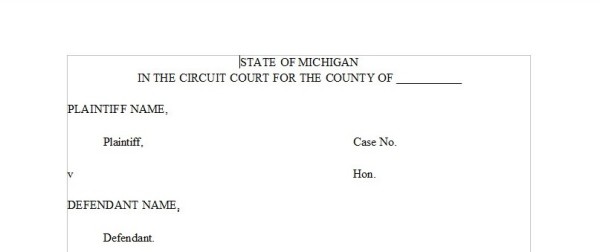
Deposition Notice Sample 1


Names and Addresses of Attorneys

The names and addresses of each attorney of record should be included on the notice. Be sure to include the attorney’s bar number and designate which party the attorney is representing. You should also include the name of an attorney’s law firm, full street address, telephone number, fax number and email address.
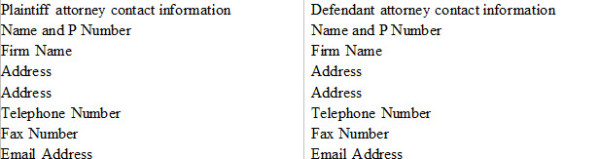
Deposition Notice Sample 2


Type of Notice

The title of the document should include the type of notice you are preparing. There are several types of deposition notices and including the title will provide clarification of which type you are preparing.

Date, Time and Location

The date, time and location should be prominently included in the notice language. Using bold type is a nice way to draw attention to this information on the notice.
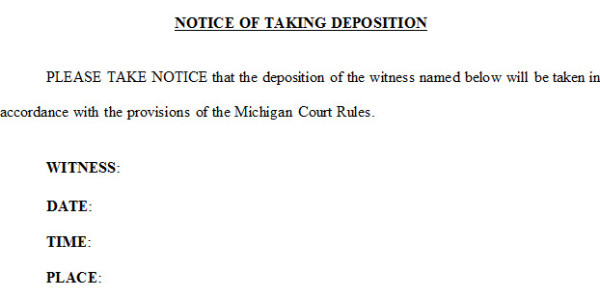
Deposition Notice Sample 3


Signature Block of the Requesting Attorney

Including the requesting attorney’s signature block at the end of the notice allows everyone to be clear on who is calling for the deposition.

Deposition Notice Sample 4


Putting It All Together

Below is a simple Notice of Deposition sample showing you all of the pieces put together to create the full document.
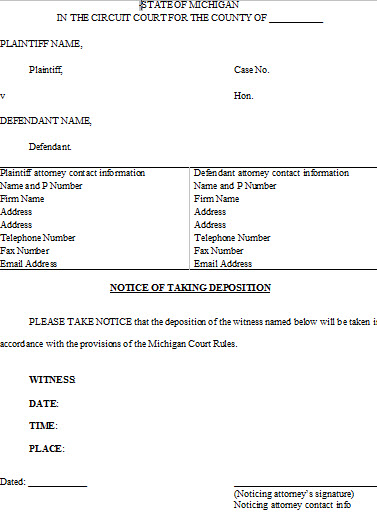

Full Deposition Notice Sample

Filed Under: Legal Professionals

November 14, 2014 By Dawn Houghton

Easily Connect to Your Court Reporter’s Realtime Transcription

How To Connect To RealtimeAt O’Brien and Bails, we have been providing realtime transcription for quite some time. Our clients find great value in viewing the transcribed spoken word as it is happening. If you’ve never connected to realtime in a deposition before, you may think it is technically difficult. But connecting to realtime is actually simple. Once you know what is involved, you will see that using realtime in your next deposition can be easy and of great value to you and your clients.

What is Realtime Transcription?

In a nutshell, realtime transcription is a system whereby the spoken word is recorded by the court reporter and delivered as text on a computer screen within a few seconds of the words being spoken.

Valuable Features of Realtime Transcription

  • A rough draft of the written record is available shortly after the proceeding has ended.
  • You have the ability to search for keywords in the text.
  • Text can be copied and pasted into other documents or emails.
  • Transcripts can be shared by the Internet or email.
  • During the deposition, reference can be made to previous testimony.
  • Drafts can be used to organize the next deposition you may be taking.
  • Answers can be reviewed immediately, giving you the opportunity to ask for further clarification if necessary.

How to Connect to Realtime

Connecting your computer to realtime is not difficult. Each court reporting firm may use different software and the process may vary from system to system. It is a good idea to call your court reporting firm before the deposition and ask for a set of instructions for connecting to your court reporter’s specific software.

At O’Brien and Bails, we use two software programs to deliver realtime transcription; Eclipse and CaseViewNet. Some of our reporters use Eclipse, and others use CaseViewNet. These software programs allow us to provide instant realtime text. No matter which program your court reporter is using, you will not need to purchase software or tokens in order to connect to realtime.

Connecting to realtime is easy. Here are the steps involved in connecting with a wireless connection that your court reporter will provide. The first set of instruction is for CaseViewNet. The second set is for court reporters using the Eclipse software.

CaseViewNet Software Realtime Connection

1. Connect to the court reporter’s wireless network.

  • Verify that your computer is WiFi enabled. View or connect to the available wireless networks by right-clicking the wireless icon on your Windows taskbar.
  • Choose the court reporter’s wireless network from the available networks.
  • If required, enter the network key (pass phrase) provided by the reporter.

2. Connect to the court reporter’s realtime system.

  • Start CaseViewNet client software.
  • Click the Connect button.
  • Follow instructions in the Connection Wizard.

3. Provide your log-in credentials and connect to the event.

  • Use your name and the name of your organization.
  • Provide the event password as provided by the court reporter.

Simple instructions for connecting are provided by CaseViewNet on their website. They also provide instructions for connecting by serial port if wireless is not available.

Eclipse Software Realtime Connection

If your court reporter is using Eclipse software, the following instructions are the ones you will follow to gain a realtime connection on your computer:

1. Go to https://connect.eclipsecat.com.

2. Click the lightening bolt symbol in the lower left-hand corner of your screen.

3. Scroll to find the transcript with which you wish to connect.

4. Enter the password you have been given from your court reporter.

We Make it Easy for You to Connect

Realtime transcription can be a huge benefit to attorneys when preparing cases. We strive to provide realtime in a way that is easy and uncomplicated. If you haven’t connected to realtime transcription in a proceeding before, as you can see, it is a simple process. Your court reporter is available to assist in making the connection so you can receive realtime transcription on your computer and reap the benefits in your next deposition.

Filed Under: Legal Technology

June 16, 2014 By Dawn Houghton

They Don’t Teach You This In Court Reporting School!

court reporting lessonsAs a court reporter with 31 years of experience, I sometimes am asked to impart words of wisdom and advice to up-and-coming court reporters. When I think of the lessons I want to pass on to others, I think of some of the lessons I could only learn the hard way. While these memories are funny to think about now, I wasn’t laughing at the time. Here are a few of those gems that come to mind.

Don’t wear your white suit unless you know where you’re going.

Upon arriving at my assignment one day, I discovered I was to take a deposition at a recycling center. This would have not typically been a problem, except that I had decided to wear my winter white suit to the deposition. No problem, I thought. We will be in the office, of course, around a conference table, as always.

Unfortunately, I soon discovered we were not to be seated in a nice, pristine office setting for the deposition. Instead, I found myself perched on the only chair (which was broken, of course), with a nearby bulldozer shoveling trash into a giant pit while I tried to take down the testimony of the standing attorneys and the witness.

You can imagine what happened to the white suit. Let’s just say it would have been better to wear brown on that day!

Never put your paper steno notes down in unusual places.

I learned this particular lesson when, upon leaving a deposition, I was in the parking lot putting my equipment into the trunk of my car. Rather than juggle too may things and drop everything, I stacked the steno notes from my deposition on the bumper of my car. This, I figured, would free up my hands to finish packing my things away.

Once I finished packing up, I got in my car to leave.

Have you ever had that funny feeling that you are forgetting something? Unfortunately, I didn’t have that feeling that day. Instead, forgetting I had placed my notes on the bumper, I got in the car and pulled out of the parking lot.

Suddenly I heard a loud noise behind me. Looking in my rear-view mirror, all I could see was a huge monster-sized, perfectly-round cloud of paper chasing me down the street! I immediately stopped and got out to see what I could salvage from the tangled web of thin white strips.

Amazingly, the paper did not tear into shreds and it only took me 30 painstaking minutes to fold the notes back into their former stack. Thank goodness the notes were only a redundancy and I had the digital notes of the deposition on my computer and a computer disk. (I still have those notes, by the way.)

Don’t kid yourself into thinking you have the manual dexterity of a circus juggler.

Because I had gone on hundreds of assignments over the years, each time bringing my equipment efficiently packed in its case, this equipment sometimes feels like an added appendage of my body, as familiar as my arms and legs. So, one day, when I arrived at my destination to find I needed to climb a flight of stairs to my assignment, I didn’t think twice about grabbing everything, including my steno machine on my shoulder, my purse in my other hand, and a to-go cup full of Starbucks coffee in the same hand as my steno machine.

Lulled into this false sense of my own abilities, imagine my surprise as I ascended the stairs and felt my steno machine slip from my shoulder, land on my forearm, causing my coffee cup to jump, thereby releasing an alarming amount of coffee from the tiny hole in the lid, which flew up into the air and came down directly on my hair and the front of my skirt!

Then and there I realized that, No, I am not a circus juggler, and, Yes, I would have to take the deposition in this disheveled condition. Which I did!

Sometimes perfectly innocent maps can lead you far, far astray.

When I am preparing to take a deposition out of town, I always print a copy of the directions to my destination to take with me. One particular day, before traveling to a deposition that was many miles away, I grabbed directions quickly and headed out the door. My drive was uneventful until I realized I had taken a wrong exit and had been heading in the opposite direction for miles.

Nothing strikes me with such fear and panic as the realization that I am going to be late for an assignment. All court reporters know that is one of the unforgivable offenses of court reporting. We learn early in our careers to never ever keep a client waiting.

I was able to turn around and finally arrive at my destination. But, to this day, I still remember the client I was working with on that stressful day. Thank you, Mr. Cypher, for being so understanding!

Never assume! It makes an … well, you know the rest.

During one of my depositions when I was still rather new to court reporting, I failed to ask one of the attorneys for his name before going on the record. But I figured everything was fine because I had a deposition notice with the names of all attending parties. I assumed the attorney present was the person named on the notice.

Several days later, I was very embarrassed when I discovered that this attorney was, indeed, NOT the person named on the notice, and I had used an incorrect name throughout the entire transcript!

But lessons are exactly that, things we learn along the way. Sometimes we learn them the hard way, but we do learn. I recently found myself in a similar situation when I recognized an attorney I would be working with for the day but could not remember his name. I now have learned to say “I know who you are, but can you remind me of your name again?” This turns out much better than getting the call that, “You have my name wrong throughout this entire transcript.”

And now I would love to hear your court reporting stories of learning the hard way. I sincerely hope I’m not the only one!

If you enjoyed this article, you might also like “Court Reporters Strive for Customer Satisfaction.”

Filed Under: Court Reporting

March 6, 2014 By Dawn Houghton

Court Reporters Strive for Customer Satisfaction

Court Reporter Customer SatisfactionEvery good court reporter holds customer satisfaction high on their priority list. We want our customers to be satisfied with the work we do for them. We often pride ourselves on the lengths we will go to serve our clients. But do you know for sure that your clients have gotten the service they expect each and every time they work with you? There are specific processes your firm can put in place to better ensure that your clients are continually satisfied customers.

Are Your Clients Satisfied Customers?

1. What are your client’s expectations?

A satisfied customer is a customer who has had all of their expectations met. However, there may be expectations your clients hold of which you are unaware. If that is the case, then your customer may not be completely satisfied. You need to discover the expectations your clients hold in order for you to give better service.

But how do you discover those expectations? Some of your best clients are people you’ve worked with many times. You begin to know their preferences over time. For instance, some clients will always order transcripts upon completion of the proceeding, others prefer to wait until a case is going to trial to order. Anticipating these expectations on a case-by-case basis is good customer service. You likely already know the preferences of these long-term repeat customers.

But what if you’re working with an attorney for the first time? You won’t know if they are expecting the transcript now or at a later time. It’s important to ask as many questions as you can so that you can be sure you understand what clients expect. You may even create a list of questions to ask a new client when they call to schedule a deposition. This list can cover a wide variety of areas in which your clients might have unknown expectations.

2. What are your promises to clients?

If there are promises you and your firm have made, you need to strive to always deliver on those promises. If you promise all transcripts will be delivered within 10 business days, then all reporters must understand the importance of meeting this promise with each and every client. If they do not, and if some transcripts are delivered late, you run the risk of creating an unsatisfied customer. Managing those promises can help you keep your client’s expectations reasonable. For instance, your client expects to pay a certain page rate for transcripts. However, in the case of a rush transcript, it is good to let your client know that rush transcripts have a higher page rate to compensate reporters for the overtime work they will be putting in to complete a transcript in a very short period of time. By letting your clients know this when they begin working with you, you are managing their expectations when the need arises.

3. Are you communicating with your clients?

Keeping close communications with your clients and their assistants is important for good customer service. Keeping them apprised of any issues, should they arise, will give your customer a much better experience. If you are unable to deliver on a promise, communicating this with your client as soon as possible will raise your chances of keeping a highly satisfied customer.

4. Do you send customer satisfaction surveys?

There may be times when a good client is unsatisfied with some aspect of service. Many clients will not tell you of that dissatisfaction. So how are you to improve your customer service if you do not know an issue exists? By surveying your clients, you will receive this very valuable feedback that might otherwise never have been communicated to you. Your surveys can be formally sent through email or mail on a regular basis, such as once a quarter, or you may wish to send a survey with each transcript you deliver. Whatever mechanism you use, find a way to continually ask clients how you’re doing. Once you receive feedback, it is important to act to improve your process to eliminate the concern in the future. There may be times when you will want to communicate these improvements, showing your clients that you are listening and are being responsive to their feedback.

Court reporters are known for providing excellent customer service. To continue this tradition, it is worth taking some time to consider the expectations of your clients and whether you are meeting them to full satisfaction.

If you enjoyed this article, you might also enjoy “4 Things a Freelance Court Reporter Should Never Say in a Deposition.”

Filed Under: Court Reporters, Court Reporting

February 20, 2014 By Dawn Houghton

Attorneys Know the Value of Court Reporters

Court Reporters Customer ServiceWhen it comes to customer service, very few industries care as much as court reporters about providing an outstanding customer experience. We know attorneys rely on us to produce an accurate record. But that is not the only piece of our service on which attorneys rely. As court reporters, we may sometimes forget that our customer service skills are incredibly valuable. It is worth thinking in depth about these simple yet so important traits and know that we are truly valued by our good clients who call us for repeat business.

Here is what attorneys know about court reporters:

Court Reporters are Punctual

One of the first things we learn as court reporters is the importance of punctuality. If we are late for a deposition, it is not just an inconvenience for our client. That would be bad enough. It is very costly for everyone if the court reporter is not on time. Attorneys and the witness are losing productive time every minute they are kept waiting. Our clients know they can count on us to show up early to every meeting, deposition or hearing.

Court Reporters are Professional

Attorneys are in charge of handling their own relationships with clients. They know that when their clients show up for the proceedings, we will treat them and their clients with professionalism and courtesy. Even if situations become tense, attorneys know we will keep a cool, calm demeanor and perform our job to the best of our ability.

Court Reporters are Accurate

We spent years learning our skill of writing machine shorthand, and we have spent more years honing the skill, constantly revising and relearning better ways to write faster and more accurately. We take very seriously the job of creating a completely accurate record of what has transpired word for word. We go to great lengths to make sure we have produced a transcript that is accurate. Our clients know they can count on us to produce an accurate verbatim transcript each and every time.

Court Reporters Deliver On Time

Every reporter learns to work under a deadline. Each time we are hired to produce a transcript, we are providing an important document that will be used in a legal matter. We know there are real people behind every caption, real people who are waiting for the legal process in order to receive justice. Court reporters understand that every transcript needs to be delivered in a reasonable number of days following the proceedings. We also know that sometimes our clients do not have a reasonable time available. Sometimes they need our transcript tomorrow morning in order for them to effectively meet their own deadlines and serve their clients to the best of their ability. We are happy to provide transcripts even if it means staying up all night to finish on time because we know people are counting on us. Our clients know we will go the extra mile to deliver a transcript to them when they need it. They appreciate the fact that we will deliver on time.

Court Reporters are Attentive

Each client who hires us is working on a matter that is of utmost importance to their own clients. We know our clients are working to deliver the best possible result for their clients. Attorneys know their court reporters understand the importance of the matter. They trust that we will give them our close attention. They know, when possible, we will anticipate their needs.

Court Reporters are Appreciative

There are many ways in which we are appreciative of our clients. We appreciate that they provide good quality work to us. We appreciate that they call us repeatedly to perform our services. We appreciate that they treat us with respect during the proceedings. We appreciate it when they pay their bills on time. Attorneys know court reporters are appreciative and thankful for their clients and the business they bring.

Court Reporters are Personable

We often have the opportunity to converse with our clients before and after proceedings. Because our clients use our services repetitively, we get many opportunities to learn about them, their practice and their goals. Attorneys value that we take the time to get to know them, that we view them as people and not just a paycheck.

Court Reporters are Tech-Savvy

Technology has become an integral part of being a court reporter. Attorneys rely on us for all sorts of technology needs. They know we can arrange and conduct a realtime deposition or video proceedings, even remote depositions over the internet. They know we have different formats of transcripts to offer and will help them discern which format they need for their practice management software. Attorneys know if they have technology questions, it is likely their court reporter will be able to help them directly or will know how to get assistance for them.

Every time I see an example of bad customer service, I think about how good court reporters are at providing excellent service. It is a good idea to remind ourselves of just how much our clients rely on us to provide that service, and they show their appreciation every time they call us to schedule another deposition or hearing.

Good customer service is a philosophy, not just a skill. Court reporters live this philosophy and always strive to deliver the best customer service on which attorneys can rely.

If you liked this article, you might also enjoy “The Importance of Punctuality for Court Reporters.”

Filed Under: Court Reporters, Court Reporting

  • 1
  • 2
  • 3
  • …
  • 5
  • Next Page »

Copyright © 2026 · O'Brien & Bails | Michigan Court Reporters
251 N. Rose Street, Suite 200
Kalamazoo, MI 49007-3943
(Get Directions)
269.345.8436 · 800.878.8750 · Email Us
Image Credit